Bhubaneswar/ Balangir: The revival of water bodies is often spoken of in terms of conservation and agriculture, but at times, it becomes something larger—a cultural renewal and a binding force for communities. The story of the Amrit Sarovar at Nuamunda Tank in Khagsikana village of Balangir district is one such example, where administrative planning and community participation came together to transform a neglected tank into a living symbol of pride and prosperity.
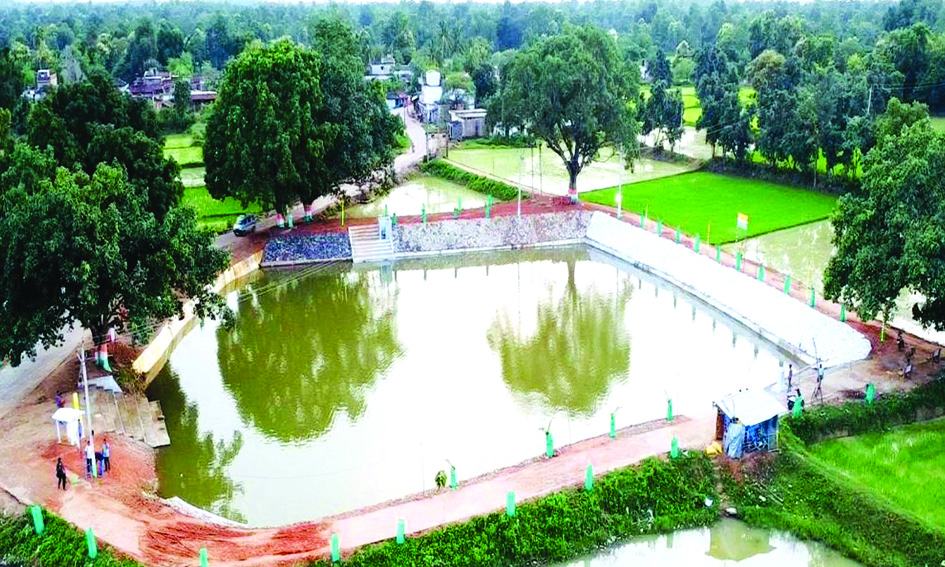
Nuamunda Tank, spread across 1.1 acres near the revered Shree Swapneswar Mahadev Temple, has always held cultural and religious significance. For decades, devotees and villagers used the tank for rituals and community gatherings. Over the years, however, it gradually lost its capacity due to silting, weakening embankments, and lack of maintenance. Though villagers tried minor repairs, the people of Gudkhapala Gram Panchayat longed for a complete transformation.
The turning point came when the block administration identified the tank under the Amrit Sarovar initiative. Technical teams assessed it with geo-spatial tools, while farmers, self-help groups, PRI members, and elders shaped its vision. With the Sarpanch as motivator, it was decided to rejuvenate the tank to serve both tradition and modern needs.
With ₹10 lakh from MGNREGS and ₹5 lakh from Finance Commission Grants, the Panchayat Samiti deepened the tank to its 10,000 cubic meter capacity, reinforced embankments, stabilized slopes, and cleared encroachments. Shady and ornamental trees, seating, and lighting turned it into a vibrant community space. Villagers themselves joined plantation and maintenance, making the Amrit Sarovar a true people’s project. The rejuvenation work was finally completed in the year 2024.
The transformation has revived cultural pride and restored the site’s spiritual aura. Agricultural benefits include improved water retention, soil moisture, and scope for short-term crops. Groundwater recharge, pisciculture, and floriculture now support livelihoods, while trees, lighting, and seating provide recreation and well-being.
It is to be noted that 7075 sites in Odisha have been identified under the Amrit Sarovar Mission, with work ongoing at 487. These multipurpose projects support irrigation, beautification, cultural preservation, animal use, and groundwater recharge, linking ecological restoration with social and livelihood benefits.
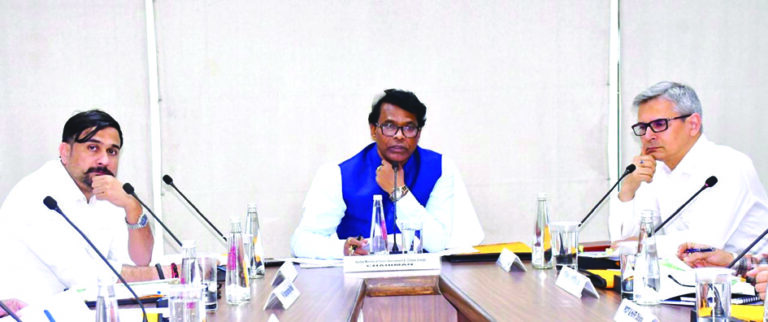
This is going as a process across Odisha. The mission is being steered by the Hon’ble Minister for Panchayati Raj and Drinking Water, Shri Rabi Narayan Naik, under the overall visionary leadership of Chief Minister Mohan Charan Majhi. It reflects the spirit of grassroot leadership and showcases how transformation is being driven at the ground level. Speaking about the project, Sarpanch Smt. Jibani Dash said it is a model of community participation and convergence, connecting people emotionally, culturally, religiously, and economically.
The Nuamunda Amrit Sarovar is therefore much more than a rejuvenated water body. It stands as a living model of how administrative will, financial convergence, and community participation can breathe new life into natural resources and revive the spirit of Panchayati Raj.